
Reposted with permission from Waggoner Nov 30, 2024. Original article.
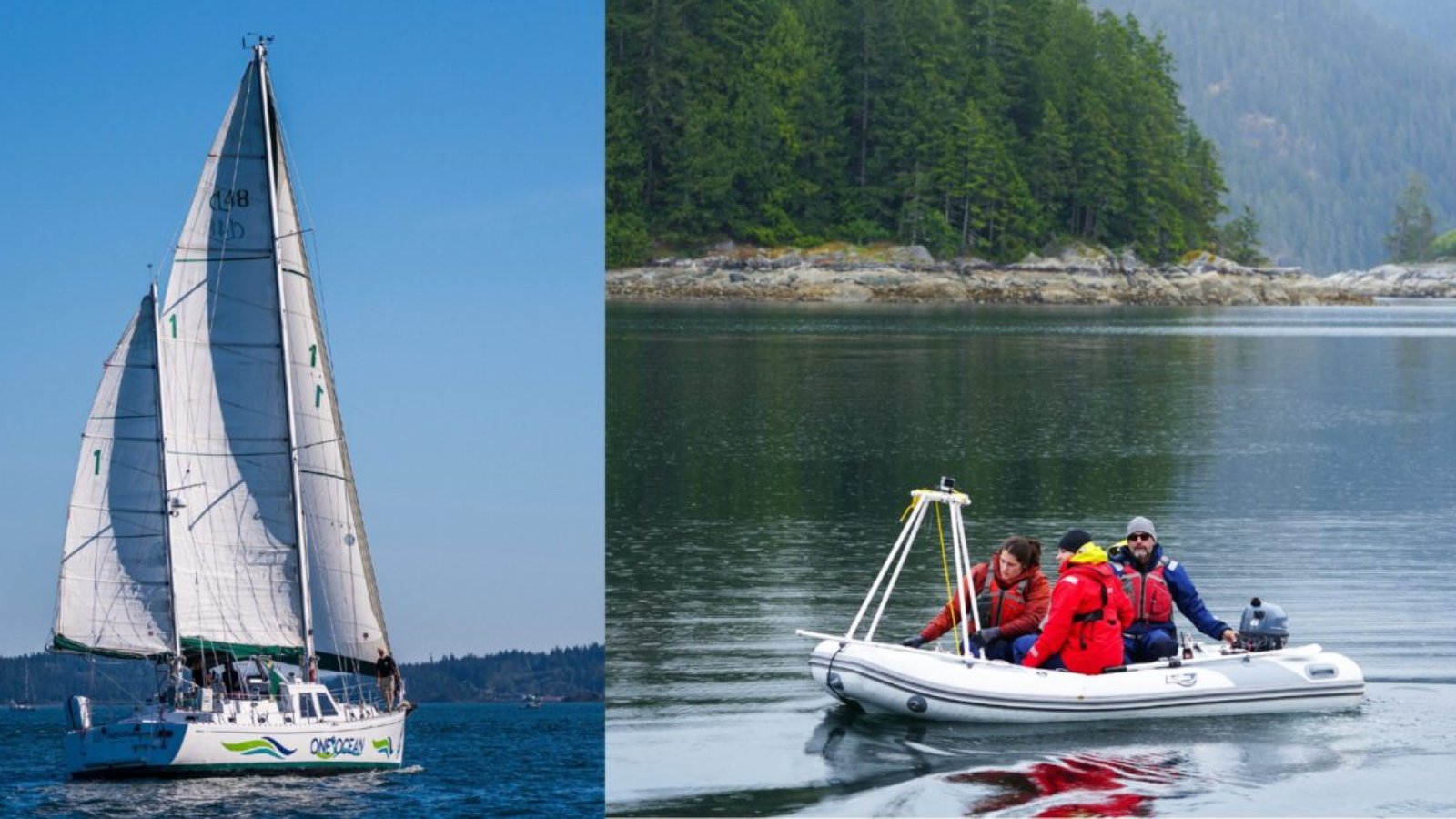
There have been significant, noteworthy firsts in science thanks to the crew of s/v One Ocean and the Around the Americas Expedition. Thanks to their on-board meteorological station, microSWIFT buoy drops, polar observations, and underwater images of kelp beds, scientists are gathering data from s/v One Ocean not previously available for study.
Completing the Studies and Getting the Crew Home. The crew of One Ocean desperately needs your help to continue this important scientific research. Please contribute to this ongoing effort to complete scientific studies and get our sailors and scientists safely back home. You can be part of this exciting mission by providing your financial support. Read below about their successful scientific studies to-date:
Heat Flux Data. Dr. Andrew Jessup, Senior Oceanographer with University of Washington Applied Physics Lab, reported receiving a unique set of data from s/v One Ocean during their sail through challenging Atlantic storms. He stated that “no one has ever made these measurements of the bulk skin temperature difference above a wind speed of about 15 meters per second or at these very high heat fluxes; we never would have seen that data if One Ocean hadn’t gone through that storm.” An infrared sea surface temperature sensor is mounted at the top of the mast on s/v One Ocean and another sensor at the thru-hull just below the waterline. Together, these instruments allow measuring temperature difference continuously.

Bulk Skin Temperature refers to the difference between the actual thin ocean surface temperature (skin temperature) and the subsurface temperature (bulk temperature), it’s a crucial distinction for understanding air-sea heat exchange. CO2 uptake and heat transfer between the ocean and atmosphere occurs at the skin. The temperature of the ocean at the surface is usually a few tenths of a degree Celsius cooler than the bulk temperature just millimeters below. Though the difference is small, on a global scale it plays an important role. Wind speed, solar radiation, and atmospheric humidity influence this difference, which is vital for climate models.

microSWIFT Buoy Drops. Data from the microSWIFT buoy drops conducted by One Ocean in partnership with Sailors for the Sea, provides insights into patterns of surface waves and temperature, both of which affect ocean-atmosphere exchange noted Dr. Jim Thomson, Environmental Engineer with UW Applied Physics Lab. “Collaboration with the Around the Americas crew allowed us to collect data in regions that are rarely accessed with direct measurements.” He further stated that “the provision of real-time data via satellite telemetry helps assist in the safe navigation and operation of other vessels at sea.” Each buoy provides over five weeks of continuous, real-time data on waves, wind, turbulence, and currents.

Polar Ice Observations. As stated by Harry Stern, Polar Ice Scientist with UW Applied Physics Lab, “there is no substitute for on-the-ground (on-the-water) observations of sea-ice conditions such as those provided by One Ocean. Commonly available satellite data does not have fine enough resolution to determine whether the sea ice is passable or not.” Small blockages of sea ice may persist for a long time, even in summers, depending on wind speed and direction, and air and water temperature. Harry Stern reported that “One Ocean’s progress helped to understand what sort of features in MODIS images may be danger signs for navigation.”

Lessons from Kelp Study. Grace Dalton, with the University of Victoria and crew member aboard One Ocean, has been collecting submerged imagery of kelp beds over an extensive area. Her underwater video footage clearly shows regional differences in kelp density, canopy structure, and composition. Grace explains that “by studying the entire West Coast as one connected system, we can begin to see large scale patterns that are impossible to detect from isolated, local studies.” Understanding how kelp health, density, and associated species change across latitude is essential for identifying where kelp is most resilient and where it is most at risk.

“Collecting data consistently across the entire West Coast under one expedition and one methodology creates a rare-coast-wide visual baseline that has not existed before.” Grace explains that this will become increasingly important as the crew of One Ocean moves into South America to complete the latitudinal comparison. “These observations would not be possible without the scale and access provided by the Around the Americas Expedition.” Dr. Maycia Costa at the University of Victoria has confirmed that “the kelp data collected is not only first-rate, but also the first of its kind.”


Shared with Classrooms. Partnering with “Exploring by the Seat of Your Pants,” s/v One Ocean hosts live classroom presentation that connect students with science and exploration. Every session is recorded and made freely available on YouTube. As Jennifer Dalton, Director of Around the Americas, says, “thousands of students around the world are watching our classroom presentations, and the inspiration goes both ways.”
Where to Donate. The Skagit Valley College Foundation (SVC) is the fiduciary IRS 501 (c) (3) nonprofit partner for Around-the-Americas. To donate online, go to https://www.mysvc.skagit.edu/cvvpay/forms/foundation_giving_form.aspx. Whatever you can donate will be greatly appreciated, please donate now so this great work can continue, and we can get the crew safely home.
You can also show your support by purchasing Around-the-Americas logo sweatshirts, hats, and/or T-shirts by going to www.oneislandoneocean.com and click on “shop”.
Photos Credit: s/v One Ocean Crew
Route Map Credit: Leonard Landon
The crew of s/v One Ocean is currently sailing south along the west coast of South America heading for Lima, Peru.